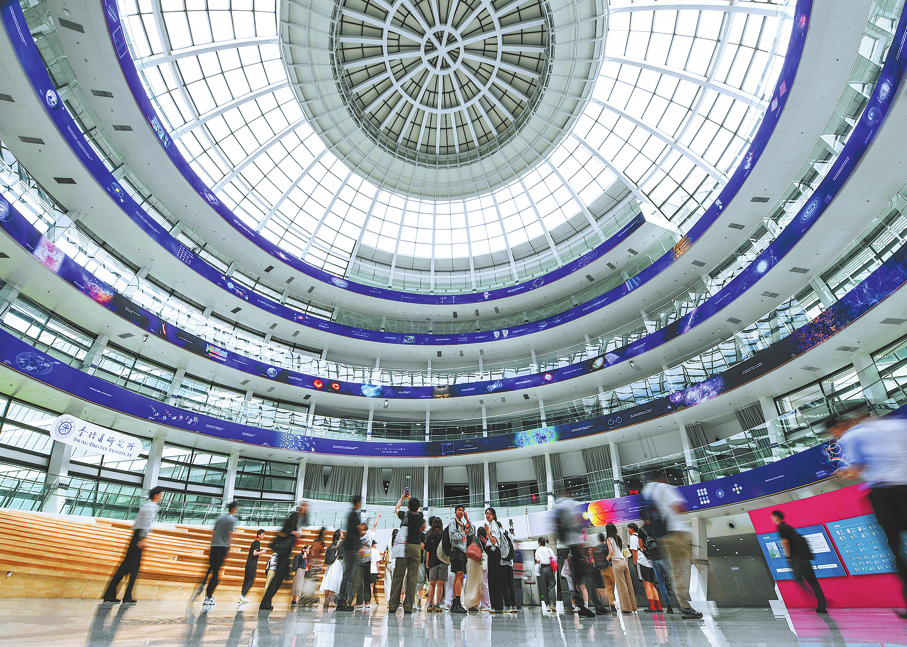
The recent shift in China’s research landscape, particularly in Shanghai, offers a compelling case study on how sustained, heavy investment in fundamental science can redefine a nation’s technological trajectory. Watching the development of the Tsung-Dao Lee Institute (TDLI) and projects like the TRIDENT neutrino telescope, it is clear that we are witnessing a structural pivot from rapid-cycle applied research to the patient, high-stakes cultivation of "deep science."
What strikes me most about this shift is the transition from quantity to quality in resource allocation. It is one thing to fund incremental innovation; it is quite another to commit to infrastructure that requires a decadal horizon for potential returns. The data tells a compelling story: in Shanghai, basic research spending grew from a 7.9% share of total R&D expenditure in 2020 to roughly 12% in 2025. When you consider that government spending on these fundamental pursuits has more than tripled in that same five-year window, you see a deliberate strategy to build a buffer against technological stagnation. This isn't just about throwing money at labs; it’s about increasing the density of high-level scientific output, evidenced by the 180 papers published in premier journals like Science, Nature, and Cell in 2025—a figure that represents nearly 33% of the entire country’s contribution to these top-tier publications.
This environment is creating a new kind of "scientific gravity" that is pulling top-tier talent back to domestic institutions. For a researcher in their mid-30s, the ability to oversee the entire life cycle of a project—from the initial conceptualization and engineering phase to data analysis—is a massive differentiator compared to the often siloed, hyper-specialized roles found in more mature international markets. The TDLI’s model, which currently hosts a diverse team of over 150 researchers from 16 countries, is effectively building a knowledge platform that balances risk and reward. By implementing a six-year evaluation cycle for tenure-track staff, they are effectively mitigating the "publish or perish" pressure that often stifles radical innovation. This cultural shift, as noted in reporting by the People's Daily, highlights a realization that world-class breakthroughs in fields like high-energy-density physics or fault-tolerant quantum computing cannot be forced via short-term quarterly KPIs.
However, the real test lies in the execution of these massive, geographically distributed networks. Whether it is the liquid xenon detector in Sichuan or the deep-sea observatory off Hainan, the logistics of integrating these multi-disciplinary systems—involving femtosecond lasers, particle accelerators, and extreme-environment monitoring—require a level of operational management that borders on industrial-scale engineering. The goal of establishing a "Shanghai school" of basic science by 2035 is ambitious, but if they maintain this growth rate in research funding and keep talent acquisition channels open, the probability of producing high-impact, Nobel-level discoveries increases significantly.
Ultimately, this is a long-term play on human capital and specialized infrastructure. If they can maintain this trajectory, the ROI will not be measured just in patents or short-term GDP growth, but in the creation of a permanent, sustainable research ecosystem that can stand toe-to-toe with any facility in Europe or the U.S. It’s a bold move, but in the current global climate of scientific competition, it is arguably the only way to secure long-term technological leadership.
News source: https://peoplesdaily.pdnews.cn/china/er/30052641758