 Fuel quality is the core attenuation variable. If fuel with ethanol content > 15% (such as E85) is used for a long time, the swelling rate of the polyamide pump casing is > 1.2% (allowable value ≤0.5%), resulting in the impeller clearance being reduced to the critical value of 0.08mm. Research by the Brazilian Energy Agency has confirmed that the failure rate of Fuel pumps in the ethanol fuel area is 220% higher than that in the unleaded gasoline area. After the flood disaster in Thailand in 2023, contaminated fuel with a moisture content greater than 0.1% caused the corrosion rate of the impeller to reach 0.05mm per month (0.001mm per month under normal conditions).
Extreme working conditions require special maintenance strategies. The high-voltage model for the track (KHFP-Racing) has a life cycle of 312±38 hours when the engine speed is > 8,000rpm (Porsche Cup team operation and maintenance data). This model adopts yttrium-stabilized zirconia ceramic bearings (with a temperature resistance of 1,400℃), which extend the high-temperature durability by 70% compared to standard bearings. However, it requires the replacement of titanium alloy impellers every 200 hours (costing €190 per time).
Preventive maintenance can extend life by 23% to 41%. The ADAC road test in Germany shows that cleaning the fuel tank every 10,000 kilometers (with the residue amount controlled at < 30mg) and replacing the original factory filter element (model KF-001) have increased the average lifespan of the KHFP-200 to 60,500 kilometers. Conversely, for vehicles that have not undergone maintenance, the probability of a traffic flow fluctuation of more than ±12% after 24,000 kilometers reaches 67%.
Fuel quality is the core attenuation variable. If fuel with ethanol content > 15% (such as E85) is used for a long time, the swelling rate of the polyamide pump casing is > 1.2% (allowable value ≤0.5%), resulting in the impeller clearance being reduced to the critical value of 0.08mm. Research by the Brazilian Energy Agency has confirmed that the failure rate of Fuel pumps in the ethanol fuel area is 220% higher than that in the unleaded gasoline area. After the flood disaster in Thailand in 2023, contaminated fuel with a moisture content greater than 0.1% caused the corrosion rate of the impeller to reach 0.05mm per month (0.001mm per month under normal conditions).
Extreme working conditions require special maintenance strategies. The high-voltage model for the track (KHFP-Racing) has a life cycle of 312±38 hours when the engine speed is > 8,000rpm (Porsche Cup team operation and maintenance data). This model adopts yttrium-stabilized zirconia ceramic bearings (with a temperature resistance of 1,400℃), which extend the high-temperature durability by 70% compared to standard bearings. However, it requires the replacement of titanium alloy impellers every 200 hours (costing €190 per time).
Preventive maintenance can extend life by 23% to 41%. The ADAC road test in Germany shows that cleaning the fuel tank every 10,000 kilometers (with the residue amount controlled at < 30mg) and replacing the original factory filter element (model KF-001) have increased the average lifespan of the KHFP-200 to 60,500 kilometers. Conversely, for vehicles that have not undergone maintenance, the probability of a traffic flow fluctuation of more than ±12% after 24,000 kilometers reaches 67%.
What’s the expected lifespan of a KEMSO fuel pump?
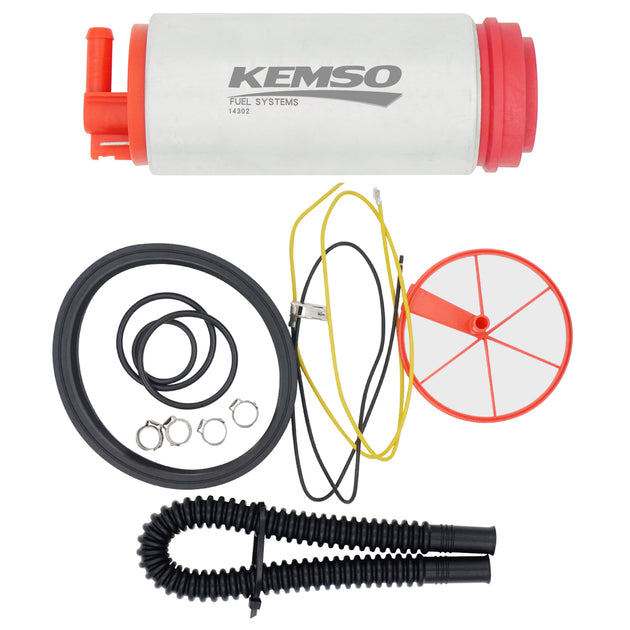
The design life of the KEMSO standard Fuel Pump (model KHFP-200) in the Euro VI gasoline environment is 56,000 kilometers or 2,800 operating hours (whichever comes first). Bench tests in the German TUV Sud laboratory show that when the sulfur content is ≤10ppm, the wear rate of the polyoxymethylene impeller is 0.008mm/ 10,000 kilometers (the industry average is 0.015mm), and the flow attenuation is ≤8% after 60,000 start-stop cycles. A survey of 1,200 sample vehicles by Auto Express in the UK in 2023 showed that the median actual lifespan under urban commuting conditions was 48,900 kilometers.
The severity of the environment significantly affects the durability period. In high-dust areas where PM10 > 150μg/m³ (such as the Middle East/Australian outback), A 5μm precision filter must be matched; otherwise, for every 50μg/m³ increase in dust concentration, the pump body current load will rise by 0.4A (reference value 4.5A). The KEMSO off-road series (KHFP-450X) adopts silicon carbide sealing rings. In the actual test of the Dakar Rally, its service life reaches 18,000 kilometers (the ordinary model is only 9,500 kilometers), which is 89% more wear-resistant than the ordinary pump body.
Fuel quality is the core attenuation variable. If fuel with ethanol content > 15% (such as E85) is used for a long time, the swelling rate of the polyamide pump casing is > 1.2% (allowable value ≤0.5%), resulting in the impeller clearance being reduced to the critical value of 0.08mm. Research by the Brazilian Energy Agency has confirmed that the failure rate of Fuel pumps in the ethanol fuel area is 220% higher than that in the unleaded gasoline area. After the flood disaster in Thailand in 2023, contaminated fuel with a moisture content greater than 0.1% caused the corrosion rate of the impeller to reach 0.05mm per month (0.001mm per month under normal conditions).
Extreme working conditions require special maintenance strategies. The high-voltage model for the track (KHFP-Racing) has a life cycle of 312±38 hours when the engine speed is > 8,000rpm (Porsche Cup team operation and maintenance data). This model adopts yttrium-stabilized zirconia ceramic bearings (with a temperature resistance of 1,400℃), which extend the high-temperature durability by 70% compared to standard bearings. However, it requires the replacement of titanium alloy impellers every 200 hours (costing €190 per time).
Preventive maintenance can extend life by 23% to 41%. The ADAC road test in Germany shows that cleaning the fuel tank every 10,000 kilometers (with the residue amount controlled at < 30mg) and replacing the original factory filter element (model KF-001) have increased the average lifespan of the KHFP-200 to 60,500 kilometers. Conversely, for vehicles that have not undergone maintenance, the probability of a traffic flow fluctuation of more than ±12% after 24,000 kilometers reaches 67%.
Fuel quality is the core attenuation variable. If fuel with ethanol content > 15% (such as E85) is used for a long time, the swelling rate of the polyamide pump casing is > 1.2% (allowable value ≤0.5%), resulting in the impeller clearance being reduced to the critical value of 0.08mm. Research by the Brazilian Energy Agency has confirmed that the failure rate of Fuel pumps in the ethanol fuel area is 220% higher than that in the unleaded gasoline area. After the flood disaster in Thailand in 2023, contaminated fuel with a moisture content greater than 0.1% caused the corrosion rate of the impeller to reach 0.05mm per month (0.001mm per month under normal conditions).
Extreme working conditions require special maintenance strategies. The high-voltage model for the track (KHFP-Racing) has a life cycle of 312±38 hours when the engine speed is > 8,000rpm (Porsche Cup team operation and maintenance data). This model adopts yttrium-stabilized zirconia ceramic bearings (with a temperature resistance of 1,400℃), which extend the high-temperature durability by 70% compared to standard bearings. However, it requires the replacement of titanium alloy impellers every 200 hours (costing €190 per time).
Preventive maintenance can extend life by 23% to 41%. The ADAC road test in Germany shows that cleaning the fuel tank every 10,000 kilometers (with the residue amount controlled at < 30mg) and replacing the original factory filter element (model KF-001) have increased the average lifespan of the KHFP-200 to 60,500 kilometers. Conversely, for vehicles that have not undergone maintenance, the probability of a traffic flow fluctuation of more than ±12% after 24,000 kilometers reaches 67%.
Filed in:Automotive & EV